How to Politely Interrupt Someone in a Conversation is a skill crucial for effective communication. We’ve all been there: needing to interject to clarify a point, offer new information, or simply keep the conversation on track. But interrupting, when done poorly, can be perceived as rude or dismissive. This guide dives into the art of polite interruption, transforming a potential faux pas into a valuable conversational tool.
This comprehensive guide will equip you with the knowledge and techniques to navigate the delicate balance of interjecting respectfully. From understanding the ‘why’ behind interruptions and mastering pre-interruption signals to practicing in various scenarios and avoiding common pitfalls, you’ll learn how to seamlessly enter a conversation without causing offense. Get ready to transform your communication style and become a more effective conversationalist.
Understanding the Importance of Polite Interruptions
Polite interruptions are a crucial skill for effective communication. While often perceived negatively, strategically interrupting can be necessary and even beneficial in various conversational scenarios. Understanding when and how to interrupt politely is key to navigating conversations smoothly and ensuring your voice is heard without causing offense.
Situations Where Interruptions Are Necessary
There are several instances where interrupting a conversation is not only acceptable but sometimes essential for maintaining clarity and ensuring safety or efficiency. These situations typically involve time constraints, critical information, or a need for clarification.
- Clarifying Misunderstandings: Sometimes, a speaker might use ambiguous language or make a statement that is easily misinterpreted. Interrupting to ask for clarification can prevent misunderstandings and ensure everyone is on the same page. For example, if someone says, “I’ll be there around 6,” interrupting with, “Do you mean 6 PM or 6 AM?” can avoid a potential scheduling conflict.
- Correcting Factual Errors: In discussions where accuracy is important, it’s sometimes necessary to politely correct factual errors. This is especially true in professional settings or when discussing sensitive topics. For instance, if someone claims a company’s profits have decreased when they’ve actually increased, a gentle correction with supporting data is appropriate.
- Preventing Misinformation: When a speaker is spreading false information, a polite interruption to correct them is important to prevent the spread of harmful narratives. This is particularly relevant in areas such as health, finance, or politics.
- Ensuring Safety or Preventing Harm: If someone is about to make a dangerous statement or take an action that could lead to harm, a swift interruption is vital. This might include a colleague about to make a significant financial decision based on flawed data or someone about to share sensitive personal information publicly.
- Managing Time and Staying on Topic: In meetings or group discussions, time constraints often necessitate interruptions to keep the conversation on track. If a speaker is going off on a tangent or running over their allotted time, a polite interruption can help refocus the discussion.
Negative Consequences of Impolite Interruptions
Interrupting someone impolitely can have several negative consequences, ranging from damaged relationships to a loss of credibility. Understanding these consequences highlights the importance of mastering polite interruption techniques.
- Damaged Relationships: Constantly interrupting someone, especially without acknowledging their contributions, can make them feel disrespected, unheard, and undervalued. This can strain personal and professional relationships.
- Perceived Rudeness and Disrespect: Impolite interruptions are often perceived as rude and disrespectful. This can lead to negative judgments about your character and communication skills.
- Loss of Credibility: Interrupting someone frequently or inappropriately can make you appear impatient, arrogant, or ill-prepared. This can erode your credibility and make it less likely that others will take your statements seriously.
- Missed Information: Impolite interruptions can disrupt the flow of a conversation and cause you to miss important information. You might not fully understand the speaker’s point, leading to confusion and misunderstandings.
- Reduced Collaboration: When people feel interrupted and dismissed, they are less likely to share their ideas and collaborate effectively. This can stifle creativity and innovation in group settings.
Benefits of Mastering Polite Interruption Techniques
Developing the ability to interrupt politely offers significant advantages in various aspects of life, from personal relationships to professional settings.
- Improved Communication: Polite interruptions facilitate clearer and more efficient communication by allowing for clarification, correction, and the timely exchange of essential information.
- Increased Respect: When you interrupt politely, you demonstrate respect for the speaker and the conversation, enhancing your reputation as a considerate communicator.
- Enhanced Influence: Mastering polite interruption techniques can help you assert your ideas and perspectives more effectively, increasing your influence in discussions and negotiations.
- Stronger Relationships: Polite communication fosters stronger and more positive relationships, both personally and professionally.
- Greater Professional Success: The ability to navigate conversations effectively, including knowing when and how to interrupt, is a valuable skill that can contribute to your success in the workplace.
Pre-Interruption Signals and Preparation
Effectively interrupting a conversation politely hinges on preparation. This involves recognizing subtle cues, employing specific phrases, and quickly assessing the conversational landscape. Mastering these elements significantly increases the likelihood of a smooth and respectful interruption.
Non-Verbal Cues Indicating a Desire to Interrupt
Paying attention to non-verbal cues can provide valuable insights into when it might be appropriate to interrupt. These cues often signal a natural pause or a shift in the speaker’s train of thought, making an interruption less disruptive. Observing these signals helps gauge the opportune moment to interject without causing undue friction.
- Eye Contact and Body Language: A speaker may glance away, break eye contact, or shift their body position. These actions can indicate they’re nearing the end of their thought or are anticipating a response. For example, if someone is looking at their watch while speaking, it could signal a time constraint and a potential opening for a quick comment.
- Pauses and Hesitations: Brief pauses, filled pauses (“um,” “ah”), or a change in speaking pace can signal the speaker is searching for the next word or thought. These are natural breaks where a well-timed interruption is less likely to disrupt the flow.
- Facial Expressions: A speaker’s facial expressions can convey various emotions, including a desire for input. A raised eyebrow, a slight nod, or a questioning look can be subtle cues that they’re open to a comment.
- Hand Gestures: Open palms or a gesture indicating “I’m finished” can signal the speaker is concluding their point. Conversely, repetitive hand movements, especially when the speaker is summarizing, may indicate they are nearing a natural stopping point.
Phrases to Use to Get Attention Before Interrupting
Choosing the right words is crucial for a polite interruption. The goal is to signal your intent without being abrupt or dismissive. The following phrases are designed to be respectful while ensuring you gain the speaker’s attention.
- Acknowledging the Speaker: Phrases like, “That’s a great point…” or “I agree with…” immediately show respect for the speaker’s contribution before you add your thoughts.
- Seeking Permission: Use phrases like, “May I add something?” or “Can I jump in for a moment?” to directly request permission. This is especially important in formal settings or with individuals you don’t know well.
- Using Time-Sensitive Language: If your interruption is brief or relevant to the immediate conversation, phrases like, “If I could just add quickly…” or “Just a quick thought on that…” can be effective.
- Offering a Counterpoint with Respect: To present a different perspective, start with phrases such as, “I see it a little differently…” or “Building on what you said…” to acknowledge the speaker’s perspective before sharing your own.
- Expressing Agreement and Seeking Clarification: “That’s interesting, and I was wondering…” or “I understand, but could you clarify…” allows you to engage while politely requesting clarification or offering a counterpoint.
Example Phrases:
- “Excuse me, may I add something?”
- “That’s a great point, and I wanted to mention…”
- “If I could just jump in for a moment…”
How to Quickly Assess the Conversational Context Before Interrupting
Before interrupting, it is essential to quickly evaluate the conversation’s context. This involves understanding the topic, the speaker’s emotional state, and the overall tone of the discussion. This assessment helps determine if an interruption is appropriate and how to frame it respectfully.
- Topic of Discussion: Is the topic factual, emotional, or sensitive? Interruptions are generally less disruptive in factual discussions, but more care is needed in emotional or sensitive conversations. For instance, interrupting someone discussing a recent loss requires more sensitivity than interrupting a discussion about project deadlines.
- Speaker’s Emotional State: Observe the speaker’s demeanor. Are they excited, frustrated, or calm? Interruptions should be timed and phrased differently depending on the speaker’s emotional state. A calm speaker is more receptive to interruptions than someone who is visibly upset.
- Tone of the Conversation: Is the conversation formal or informal, lighthearted or serious? The tone dictates the level of formality required in your interruption. A formal setting demands more polite and deferential language.
- Relationship Dynamics: Consider your relationship with the speaker. Are you peers, superiors, or friends? The dynamics influence how direct or indirect your interruption can be.
- Relevance of Your Contribution: Is your point directly related to the current discussion? Is it essential, or can it wait? Only interrupt if your contribution is timely and relevant to the conversation’s direction.
Checklist for Preparing to Politely Interrupt a Conversation
A checklist helps ensure that you approach interruptions with consideration and respect. This checklist covers all the crucial steps, from observing non-verbal cues to selecting the appropriate phrasing.
- Observe and Listen: Actively listen to the speaker and watch for non-verbal cues.
- Assess the Context: Evaluate the topic, tone, and emotional state.
- Choose Your Moment: Identify a natural pause or break in the conversation.
- Select Your Phrase: Choose a polite and appropriate phrase to gain attention.
- Be Concise: Keep your interruption brief and to the point.
- Acknowledge and Respect: Show appreciation for the speaker’s contribution.
- Offer a Bridge: If possible, connect your point to the existing discussion.
- Be Prepared to Yield: If it’s not the right time, be prepared to wait.
Polite Interruption Phrases and Techniques
Interrupting someone, even when done politely, can be tricky. Choosing the right words and techniques is essential to ensure your interruption is well-received and doesn’t derail the conversation. This section will equip you with a variety of phrases and strategies to navigate these situations effectively.
Polite Interruption Phrases
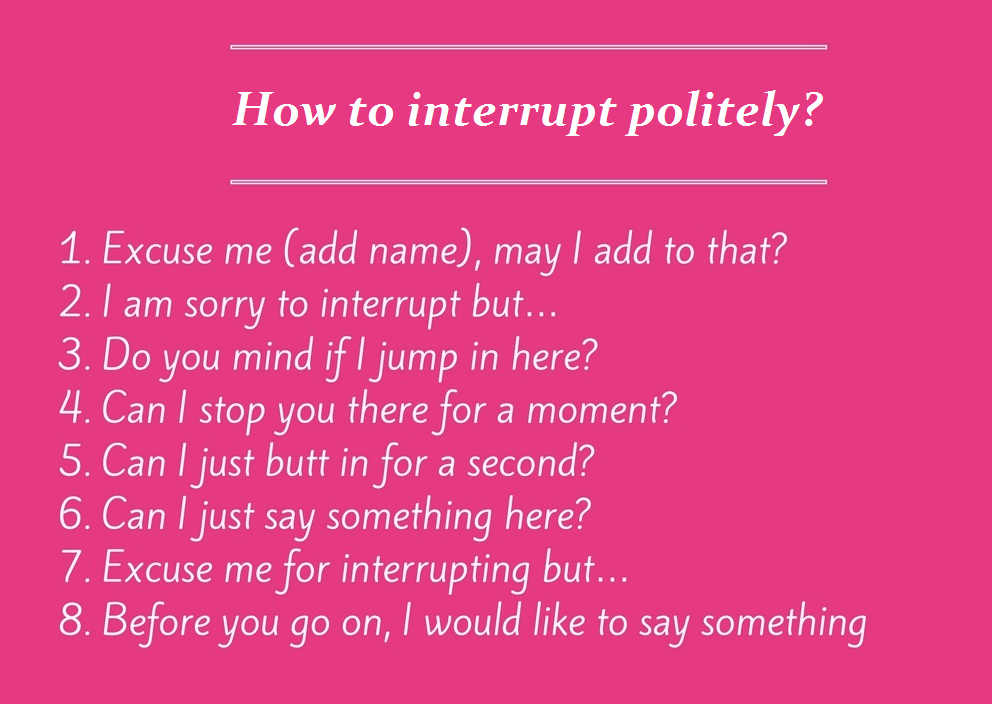
Using specific phrases can make your interruption sound more considerate and respectful. Here are some examples:
- “Excuse me, I’d like to add something quickly.”
- “I’m sorry to interrupt, but…”
- “If I could just jump in for a moment…”
- “May I briefly interject?”
- “I hate to interrupt, but I have a quick point.”
- “Forgive the interruption, but…”
- “Just to clarify…” (This is useful for seeking clarification rather than stating your own point.)
- “Could I add to that?”
Acknowledging the Speaker’s Point
Before you state your own point, it’s crucial to acknowledge what the speaker has already said. This shows you’re listening and respecting their contribution. Here’s how to do it:
- Start by agreeing: “I agree with your point about…”
- Summarize their point: “So, if I understand correctly, you’re saying…”
- Acknowledge their perspective: “That’s a valid point, and…”
- Build on their idea: “Building on what you said about…,”
For example:
“I understand your concern about the budget cuts, and I think we also need to consider…”
Interruption Techniques Based on Formality
The level of formality needed will vary depending on the context of the conversation and the relationship you have with the speaker.
- Formal: Use phrases like “Excuse me, may I interject for a moment?” or “I apologize for the interruption, but I have a point to add.” In a formal setting, it’s important to be respectful and avoid sounding abrupt.
- Informal: In more casual settings, you can use phrases like “Hey, can I just say something quickly?” or “Sorry to cut in, but…” The tone should be friendly and conversational.
- Business: During meetings, it’s appropriate to use phrases like, “If I may add to that,” or “Just to be clear…” to ensure that you are respectful while being concise.
Phrases Organized by Urgency
When you need to interrupt, the urgency of your point will dictate the phrases you choose.
- Low Urgency: Use phrases like “I’d like to add something when you have a moment” or “If I could just briefly mention…”
- Medium Urgency: Use phrases like “I’m sorry to interrupt, but I have a quick point…” or “May I jump in for a moment?”
- High Urgency: Use phrases like “Excuse me, I need to interject quickly because…” or “I’m so sorry to interrupt, but this is important.” Use these sparingly and only when necessary.
Navigating Different Conversational Scenarios

Interrupting someone politely is a skill that needs to be adapted based on the context. The formality of the setting, the relationship with the speaker, and the length of the conversation all play a role in determining the most appropriate approach. Understanding these nuances ensures your interruption is not only polite but also effective in getting your point across.
Interrupting in a Formal Meeting
Formal meetings require a higher degree of decorum. Interruptions should be infrequent and always respectful of the speaker and the meeting’s purpose. Here’s a structured approach:
- Use Pre-Interruption Signals: Before speaking, signal your intent. This could involve raising your hand (if the meeting has formal procedures), or subtly leaning forward and making eye contact with the speaker. This alerts the speaker and allows them to pause naturally.
- Choose Your Moment: Wait for a natural pause, such as the end of a sentence or a completed thought. Avoid interrupting mid-sentence unless absolutely necessary (e.g., to correct a factual error that could derail the meeting).
- Use Polite Interruption Phrases: Employ phrases that acknowledge the speaker and your reason for interrupting. For example:
“Excuse me, [Speaker’s Name], I’d like to add something here.”
“If I may, I’d like to clarify a point.”
“I apologize for interrupting, but I believe this is relevant…”
- Keep it Concise: State your point clearly and briefly. Formal meetings are often time-sensitive, so avoid rambling. Stick to the essential information.
- Offer a Brief Explanation: If you’re correcting a fact or offering a different perspective, briefly explain your reasoning. Back up your statement with data or evidence if possible.
- Defer to the Speaker: After making your point, briefly pause and allow the original speaker to respond. Acknowledge their perspective. For example:
“I understand your point, [Speaker’s Name], but I wanted to offer a different perspective based on [evidence].”
Interrupting a Friend in a Casual Conversation
Casual conversations with friends are generally more relaxed, but politeness is still key. The level of formality is lower, but respecting your friend’s time and thoughts is crucial.
- Use a Soft Approach: Begin with a gentle interjection to gain their attention.
“Hey, can I jump in for a sec?”
“Oh, that reminds me…”
“Just a quick thought on that…”
- Match the Tone: Adapt your tone to the conversation’s mood. If it’s lighthearted, your interruption can be as well. If the topic is serious, adjust your tone accordingly.
- Be Mindful of Timing: Interrupt at a natural pause, but don’t be afraid to interject if the conversation is veering off course or you have something urgent to add.
- Acknowledge Their Point: Show that you’re listening and respect their perspective. A simple “That’s a good point” or “I see what you mean” can go a long way.
- Keep it Brief: Unless you have a compelling reason to elaborate, keep your interruption concise. This shows respect for your friend’s time and the flow of the conversation.
Interrupting in a Group Discussion
Group discussions require navigating multiple perspectives. Interrupting in this setting demands extra consideration to maintain a balanced and productive exchange.
- Observe the Dynamics: Before interrupting, assess the flow of the conversation. Note who has spoken, how frequently, and the overall tone. This helps you gauge the best time and manner to interject.
- Use Pre-Interruption Signals (Subtle): Similar to formal meetings, use subtle signals like eye contact and a slight shift in posture to indicate you want to speak. This can alert the current speaker and other participants.
- Choose Your Phrase Carefully: Use phrases that acknowledge the group and the speaker. Examples include:
“Can I offer a quick thought on that?”
“I’d like to add to what [Speaker’s Name] said…”
“If I could just jump in for a moment…”
- Direct Your Comments to the Group: When you speak, address your comments to the entire group rather than singling out one person. This fosters a sense of shared participation.
- Be Respectful of Other Voices: After making your point, allow others to speak. Avoid dominating the conversation.
- Acknowledge and Build On Others’ Ideas: Whenever possible, connect your points to what others have said. This shows that you’re listening and contributing to the collective understanding. For example:
“Building on what [Speaker’s Name] mentioned, I’d also like to add…”
Strategies for Interrupting a Long-Winded Speaker
Sometimes, someone may speak for an extended period, and it becomes necessary to politely intervene. Here are strategies to manage such situations:
- Use Pre-Interruption Signals: The same techniques apply as in other scenarios. Make eye contact and lean forward to show your intention to speak.
- Choose a Strategic Moment: Look for natural pauses or opportunities to interject, such as when the speaker takes a breath or pauses to collect their thoughts.
- Employ Polite Interruption Phrases: Use phrases that acknowledge the speaker’s time and the topic.
“Excuse me, [Speaker’s Name], this is fascinating, but…”
“I appreciate your insights, but I’d like to briefly interject…”
“That’s a lot to consider, and I’d like to offer a quick clarification…”
- Be Prepared to Summarize: If the speaker is taking a long time to get to the point, you might need to summarize what you understand to be their main point. This can help steer the conversation forward. For example:
“So, if I understand correctly, your main point is… Is that right?”
- Gently Redirect the Conversation: If appropriate, gently steer the conversation back on track or toward a specific action.
“Perhaps we could now move on to…”
- Offer a Time Check (if appropriate): In formal settings, you might gently remind the speaker of time constraints.
“I’m conscious of the time, and I wonder if we could summarize this point briefly…”
Handling Reactions to Interruptions

Interrupting someone, even politely, can sometimes be met with a negative reaction. It’s crucial to know how to navigate these situations gracefully to maintain positive relationships and ensure your message is still heard. This section focuses on how to effectively respond when a speaker seems annoyed, apologize sincerely, de-escalate potential conflicts, and ultimately regain their attention.
Responding to Annoyance
When someone is interrupted, their initial reaction can vary. They might seem annoyed, frustrated, or even slightly angry. Recognizing these signs and responding appropriately is key.
- Acknowledge the Emotion: The first step is to acknowledge the speaker’s feelings. Don’t dismiss their reaction. Phrases like, “I see that I interrupted you,” or “I understand if that was a bit disruptive” demonstrate empathy.
- Stay Calm: Maintaining a calm demeanor is essential. Avoid mirroring their frustration or becoming defensive. Speaking in a steady, even tone can help de-escalate the situation.
- Listen Actively: Even if you’ve interrupted, make sure to actively listen to their response. This shows respect and a willingness to understand their perspective.
- Avoid Interrupting Again: Once you’ve apologized, resist the urge to interrupt further. Allow the speaker to finish their thought or express their feelings completely.
Apologizing and Regaining Attention
A sincere apology can often smooth over a ruffled feather and help you regain the speaker’s attention. The apology should be genuine and focused on their experience.
- Offer a Sincere Apology: Use phrases like, “I’m so sorry for interrupting,” or “My apologies for jumping in.” Make sure your apology is heartfelt.
- Briefly Explain Your Reasoning (If Necessary): If the interruption was time-sensitive or important, you can briefly explain the reason behind it
-after* apologizing. Keep it concise. For example, “I apologize for interrupting, but I wanted to quickly clarify the deadline for the project.” - Offer to Let Them Finish: Indicate your willingness to let them continue their original train of thought. You could say, “Please, finish what you were saying. I’ll wait until you’re done.”
- Rephrase Your Interruption (If Needed): If the original interruption was important, after the speaker has finished, rephrase it to ensure you address the original point, but in a way that respects their turn to speak. For example, “Now that you’ve finished, regarding the budget…”
Avoiding Escalation
Interrupting can sometimes lead to a tense situation. Preventing escalation requires careful communication and emotional intelligence.
- Control Your Body Language: Nonverbal cues are important. Avoid crossing your arms, rolling your eyes, or making other gestures that could be perceived as dismissive or confrontational. Maintain open and receptive body language.
- Choose Your Words Carefully: Avoid using accusatory language or making defensive statements. Instead, focus on taking responsibility for the interruption.
- Focus on Solutions: Shift the conversation towards finding solutions or clarifying the information, rather than dwelling on the interruption itself.
- Recognize When to Back Down: If the speaker is highly agitated, it’s sometimes best to back down and revisit the topic later. Prioritize maintaining a positive relationship over getting your point across immediately.
Script for Defusing a Potentially Tense Situation
Here’s a sample script you can adapt to defuse a potentially tense situation after interrupting:
“I’m so sorry for interrupting you just now. I realize I jumped in before you could finish your thought. I didn’t mean to be disrespectful, and I understand if it was disruptive. I was just concerned about [briefly explain your reason, if applicable]. Please, I’d like to hear what you were saying. After you’ve finished, I can quickly add [your point], if you’re open to it. I value your input and want to make sure we’re on the same page.”
This script acknowledges the interruption, apologizes sincerely, explains the reasoning (if necessary), offers the speaker the opportunity to finish, and suggests a way to move forward constructively.
Body Language and Tone of Voice
Your nonverbal cues, including body language and tone of voice, significantly influence how your interruption is perceived. Even the most polite phrasing can be undermined by negative body language or an aggressive tone. Mastering these elements is crucial for successful and respectful interruptions.
Body Language and Interruption Perception
Body language acts as a silent language, conveying your intentions and attitude. When interrupting, your body language can either support your words, indicating respect and a genuine desire to contribute, or contradict them, signaling impatience or disrespect. A study published in the
Journal of Nonverbal Behavior* highlighted that nonverbal cues can account for up to 65-93% of the impact of a communication, underscoring the importance of being mindful of your body language.
- Positive Body Language: Signals respect and attentiveness.
- Upright Posture: Standing or sitting with a straight back demonstrates engagement and respect for the speaker. Avoid slouching, which can be interpreted as disinterest or boredom.
- Open Gestures: Keeping your arms uncrossed and hands visible communicates openness and approachability. Avoid folding your arms, as this can appear defensive.
- Nodding: Gently nodding while the other person is speaking shows you are listening and understanding.
- Smiling: A genuine smile can soften the interruption and make you appear more friendly.
- Negative Body Language: Can undermine your attempt at politeness.
- Crossed Arms: Can signal defensiveness, disagreement, or a lack of interest in what the speaker is saying.
- Fidgeting: Restlessness, such as tapping your fingers or shifting in your seat, can indicate impatience or anxiety.
- Avoiding Eye Contact: Suggests you are not fully engaged in the conversation and can make the interruption seem less genuine.
- Rolling Eyes: This conveys disrespect and dismissiveness, regardless of your verbal politeness.
Tone of Voice and Politeness
Your tone of voice can drastically alter the meaning of your words. A gentle, respectful tone reinforces your polite interruption, while a sharp or demanding tone can negate your efforts, making you appear rude.
- Use a Calm and Respectful Tone: Speak at a moderate pace and volume. Avoid raising your voice or sounding accusatory.
- Modulate Your Pitch: Varying your pitch can prevent your voice from sounding monotonous and help convey sincerity.
- Avoid Interrupting with Aggression: Interruptions with an aggressive tone can make the listener feel attacked. For example, compare “Excuse me, but I believe…” to “HEY! Excuse me!”
- Practice Active Listening: Demonstrate active listening before interrupting, which helps establish rapport and show respect for the speaker. This can be as simple as saying “Yes” or “I understand.”
Maintaining Eye Contact During and After Interrupting
Eye contact is a crucial element of nonverbal communication. It conveys attentiveness, sincerity, and respect.
- Before Interrupting: Briefly make eye contact with the speaker to signal your intention to speak.
- During the Interruption: Maintain brief eye contact while you deliver your polite phrase. This demonstrates confidence and respect.
- After Interrupting: Continue making eye contact as the other person responds. This indicates you are genuinely interested in their response and the ongoing conversation.
- Avoid Staring: While eye contact is important, avoid staring, which can make the other person uncomfortable.
“Excuse me, I’d like to add something” spoken with a smile, upright posture, and direct eye contact is perceived very differently than the same words delivered with a frown, crossed arms, and averted eyes.
Cultural Considerations
Politeness, like beauty, is often in the eye of the beholder. What is considered a polite interruption in one culture might be perceived as rude in another. Understanding these cultural nuances is crucial for effective and respectful communication, especially in a globalized world. Failing to adapt your interruption style to the cultural context can lead to misunderstandings, damaged relationships, and missed opportunities.
Variations in Politeness of Interruptions Across Cultures
Conversational norms differ significantly across cultures, particularly regarding the acceptability of interruptions. Some cultures value directness and efficiency, where interruptions are common and even expected to keep the conversation flowing. Other cultures prioritize maintaining harmony and avoiding direct confrontation, making interruptions less frequent and more formal.
- High-Context Cultures: These cultures, such as those found in many parts of Asia and the Middle East, rely heavily on nonverbal cues, shared history, and implicit understanding. Interruptions might be more carefully considered and used sparingly, often to show agreement or to subtly guide the conversation. Directness is often avoided to maintain face and preserve relationships.
- Low-Context Cultures: Cultures like those in North America and Northern Europe tend to be more direct and explicit in their communication. Interruptions can be more common, especially if the speaker is perceived as rambling or if the interrupter wants to inject their viewpoint quickly. Efficiency in conveying information is often prioritized.
- Collectivist vs. Individualistic Cultures: Collectivist cultures, which prioritize group harmony and consensus, might see interruptions as a way to contribute to the group’s understanding. Individualistic cultures, which value individual expression and directness, might see interruptions as a way to assert one’s own perspective.
Examples of Conversational Norms from Different Countries
Here are a few examples to illustrate how conversational norms and interruption etiquette differ across various countries:
- Japan: In Japanese culture, interruptions are generally avoided to maintain harmony and respect. Speakers often wait for a natural pause before speaking. Direct disagreement is also rare, and subtle cues are used to convey opinions.
- France: French conversation can be lively and animated, with a higher tolerance for interruptions than in some other cultures. Interruptions can be used to express enthusiasm, agreement, or to jump in with a related idea. The flow of conversation can feel more dynamic.
- United States: American communication styles often involve a mix of directness and politeness. Interruptions can occur, particularly to clarify information or to share a contrasting viewpoint, but are often prefaced with phrases like “Excuse me” or “May I add…”.
- Germany: German communication tends to be direct and factual. Interruptions are less common than in some other cultures, and speakers are expected to finish their thoughts before being interrupted. Clarity and precision are valued.
- Brazil: Brazilians are known for their warmth and friendliness. Conversations can be energetic, and interruptions are more common, often to show enthusiasm or agreement. Physical touch and close proximity are also common during conversations.
Adapting Interruption Style Based on Cultural Context
Successfully navigating cross-cultural conversations requires adapting your interruption style. This involves being aware of the cultural norms, observing the conversational dynamics, and adjusting your approach accordingly.
- Research and Observation: Before interacting with people from a different culture, research their communication styles. Observe how people in that culture interact in conversations, paying attention to how and when they interrupt.
- Listen More Than You Speak: In the initial stages of a conversation, prioritize listening to understand the cultural norms and conversational flow. Pay attention to the speaker’s body language and the reactions of others.
- Use Pre-Interruption Signals Carefully: In cultures where interruptions are less common, use pre-interruption signals such as a slight hand raise, a nod, or a phrase like “May I add…” to signal your intention to speak.
- Choose Your Moments Wisely: Be mindful of the timing of your interruptions. Avoid interrupting during a crucial point in the speaker’s argument or when they are clearly emphasizing a point.
- Be Prepared to Adjust: Recognize that you might need to adjust your interruption style throughout the conversation based on the feedback you receive and the dynamics of the interaction.
Comparison of Interruption Etiquette in Different Cultures
The following table provides a comparative overview of interruption etiquette in several cultures. Remember that these are generalizations, and individual behavior can vary.
| Culture | Typical Attitude Towards Interruptions | Common Interruption Styles | Phrases Used to Interrupt | Key Considerations |
|---|---|---|---|---|
| Japan | Generally avoided; considered impolite | Rare; often used to show agreement or support | Subtle cues, indirect language | Prioritize harmony; avoid direct disagreement |
| France | More common; can be used to show enthusiasm | More frequent; animated and dynamic | “Excusez-moi,” “Je voudrais ajouter…” (Excuse me, I would like to add…) | Allow for lively exchange; be prepared for dynamic flow |
| United States | Varies; a mix of directness and politeness | Can be used to clarify, share viewpoints | “Excuse me,” “May I add…”, “I’d like to say…” | Balance directness with politeness; respect speaker’s turn |
| Germany | Less common; value for finishing thoughts | Less frequent; focused on clarity | “Entschuldigung,” (Excuse me) | Be direct and factual; avoid interrupting unnecessarily |
| Brazil | More common; can show enthusiasm and agreement | Frequent; energetic and engaging | “Com licença,” (Excuse me) | Embrace the energy; be prepared for a dynamic conversation |
Practicing Polite Interruptions
Mastering the art of polite interruption requires consistent practice. It’s not something you can learn overnight; it’s a skill refined through conscious effort and feedback. Regular practice, in a variety of scenarios, is crucial for internalizing the techniques and developing the confidence to use them effectively in real-world conversations.
Techniques for Practicing Polite Interruptions
Practicing polite interruptions involves a multi-faceted approach. This includes setting up practice sessions, using specific scenarios, and actively seeking feedback to identify areas for improvement.
- Set up Practice Sessions: Schedule dedicated time for practice. This could be with a friend, family member, or colleague who is willing to participate and provide constructive criticism. The goal is to create a safe and supportive environment where you can experiment without fear of embarrassment.
- Record Yourself: Use a voice recorder or video camera to capture your practice sessions. This allows you to review your performance objectively and identify any verbal or nonverbal cues that need adjustment. Pay attention to your tone of voice, body language, and the timing of your interruptions.
- Start Simple: Begin with simple scenarios and gradually increase the complexity. This helps build confidence and allows you to focus on mastering the fundamental techniques before tackling more challenging situations.
- Vary Your Practice Partners: Practice with different people to experience a range of communication styles and personalities. This will help you adapt your approach to different individuals and situations.
- Focus on Specific Techniques: During practice, concentrate on specific techniques you want to improve, such as using pre-interruption signals, choosing the right interruption phrases, or managing your body language.
Scenarios for Practicing Polite Interruptions
Creating realistic scenarios is key to effective practice. The more closely the practice mirrors real-life situations, the better prepared you will be to handle them. Here are some examples:
- Work Meeting: A colleague is presenting a proposal, and you need to clarify a point. Practice using phrases like, “Excuse me, could I just quickly ask…” or “I’m sorry to interrupt, but…”
- Informal Conversation: A friend is telling a long story, and you need to interject to steer the conversation in a different direction. Practice using phrases like, “That’s interesting, but I wanted to ask you about…” or “Speaking of which…”
- Group Discussion: Several people are talking at once, and you need to contribute your thoughts. Practice using pre-interruption signals like raising your hand or making eye contact, followed by a polite interruption phrase.
- Customer Service Scenario: You are on the phone with a customer service representative, and you need to clarify a point. Practice using phrases like, “I’m sorry to interrupt, but could you please clarify…” or “Excuse me, just to confirm…”
- Family Dinner: A family member is monopolizing the conversation, and you want to share your thoughts. Practice using phrases like, “That’s a good point, but I wanted to add…” or “Can I just jump in for a moment?”
Receiving Feedback on Interruption Skills
Feedback is an essential component of improving your interruption skills. Constructive criticism from others helps you identify blind spots and refine your technique.
- Ask for Specific Feedback: Don’t just ask, “How did I do?” Instead, ask specific questions like, “Did I interrupt too abruptly?” or “Was my tone of voice appropriate?”
- Choose Feedback Partners Wisely: Select individuals you trust to provide honest and constructive feedback. This could include mentors, colleagues, or friends who are good communicators.
- Be Open to Criticism: Approach feedback with an open mind and a willingness to learn. Don’t get defensive; instead, listen carefully and consider the feedback you receive.
- Take Notes: Keep a record of the feedback you receive, noting specific areas for improvement. This will help you track your progress over time.
- Follow Up: After receiving feedback, practice incorporating the suggestions into your next practice session. Ask for follow-up feedback to see if you have made improvements.
Role-Playing Guide for Improving Interruption Skills
Role-playing is a powerful tool for practicing polite interruptions. It allows you to simulate real-life scenarios and experiment with different techniques in a controlled environment.
- Define the Scenario: Clearly define the context of the role-play. What is the setting? Who are the participants? What is the topic of conversation? For example, a work meeting discussing a new project.
- Assign Roles: Assign roles to each participant. One person can be the speaker, while the other can be the interrupter. Consider assigning a third person to observe and provide feedback.
- Establish Goals: Set specific goals for the role-play. For example, the interrupter might aim to use a specific pre-interruption signal or a particular interruption phrase.
- Practice the Scene: Begin the role-play, allowing the speaker to talk for a few minutes before the interrupter attempts to interject. The interrupter should focus on using the chosen techniques and phrases.
- Provide Feedback: After the role-play, the observer (or the speaker) should provide feedback to the interrupter. This should include both positive comments and suggestions for improvement.
- Repeat and Iterate: Repeat the role-play, switching roles and scenarios. Continue practicing and refining your techniques based on the feedback you receive.
- Analyze and Adapt: After several role-playing sessions, analyze your performance. Identify the techniques that work well and the areas where you need to improve. Adapt your approach accordingly.
Common Mistakes to Avoid

Interrupting, while a necessary communication skill, can easily backfire if not executed correctly. This section highlights common pitfalls to avoid to ensure your interruptions are perceived as polite and contribute positively to the conversation. Understanding these mistakes will help you refine your technique and become a more effective communicator.
Phrases to Avoid When Interrupting
Certain phrases can instantly make your interruption sound rude or dismissive. It’s crucial to be mindful of the language you use.* Avoid starting with phrases that directly contradict or belittle the speaker’s point. For example, “That’s not true” or “You’re wrong” are guaranteed to shut down the conversation.
- Don’t use phrases that abruptly cut off the speaker. This includes phrases like “Hold on a second…” followed by you immediately speaking, without pausing to acknowledge the speaker’s current thought.
- Refrain from using overly assertive or demanding language. Phrases like “Let me tell you something…” or “Just listen to me…” can come across as aggressive.
- Steer clear of phrases that are irrelevant to the current topic. This can be perceived as derailing the conversation. For instance, abruptly changing the subject without a clear connection to the ongoing discussion is generally considered impolite.
- Avoid using excessive qualifiers that can undermine your point. While politeness is important, using too many “umms,” “ahs,” or hesitant phrases can make you sound unsure and less credible.
Consider these examples: Instead of saying “That’s completely wrong,” try “I have a slightly different perspective on that…” or “May I add something here?”.
Preventing a Dismissive or Rude Tone
It’s not just what you say, but how you say it. Preventing a dismissive or rude tone is essential for successful interruptions.* Acknowledge the speaker’s point before interrupting. Briefly summarize their main idea to show you’re listening and understand their perspective. For example, “So, you’re saying the project needs more resources…”
- Use respectful body language. Maintain eye contact, nod to show you are listening, and avoid interrupting with a harsh or dismissive facial expression. A neutral and attentive expression will generally suffice.
- Control your tone of voice. Speak in a calm and respectful manner. Avoid raising your voice or sounding impatient. A gentle, polite tone conveys respect for the speaker.
- Provide a clear and concise interruption. Don’t ramble or go off-topic. Get to your point quickly and efficiently.
- Offer your interruption as a contribution, not a correction. Frame your thoughts as adding to the conversation, not as a means of proving someone wrong. For example, “I’d like to build on that idea…”
Do’s and Don’ts for Polite Interruptions
Following these guidelines will help you navigate interruptions effectively.* Do:
- Choose your timing carefully. Look for natural pauses or breaks in the speaker’s flow.
- Use polite phrases to introduce your interruption.
- Summarize the speaker’s point before adding your own.
- Be brief and to the point.
- Be prepared to yield if the speaker wants to continue.
Don’t
- Interrupt frequently or dominate the conversation.
- Use aggressive or dismissive language.
- Cut off the speaker abruptly.
- Change the subject without a clear connection.
- Be overly critical or judgmental.
Illustrative Examples and Scenarios
Understanding how polite interruptions function in real-world scenarios is crucial. Seeing these techniques in action helps solidify the principles and provides practical models for effective communication. The following examples showcase the impact of well-executed and poorly-executed interruptions, as well as situations where timely interruptions are particularly beneficial.
Successful Polite Interruption Scenario
This scenario demonstrates a successful polite interruption within a professional context.A team is in a meeting discussing a new marketing campaign. The marketing lead, Sarah, is presenting her initial ideas, focusing heavily on social media engagement. After Sarah has been speaking for about five minutes, the project manager, David, recognizes a potential issue.David, using a pre-interruption signal (a raised hand and a brief pause), says, “Sarah, I’m really enjoying your presentation, and the social media focus is exciting.
Could I briefly interject with a point about budget allocation?”Sarah, acknowledging David with a nod, responds, “Of course, David.”David then continues, “From our initial projections, the budget allocated to social media may be insufficient to achieve the ambitious engagement goals you’ve Artikeld. We might need to consider reallocating funds from print advertising.”He then offers a quick summary, followed by a phrase to smoothly return control back to Sarah: “I just wanted to raise that point for consideration.
Sarah, please, continue with your presentation.”Sarah then thanks David for the insight, and the team briefly discusses the budget implications before Sarah continues with her presentation.
Unsuccessful Interruption Scenario
This scenario illustrates an unsuccessful interruption and the negative consequences that can arise.During a client presentation, the sales representative, Mark, is explaining the features of a new product. He is focusing on the technical specifications and is struggling to connect with the client, who seems disengaged. Mark’s colleague, Lisa, believes she can steer the conversation in a more compelling direction.Lisa abruptly cuts in, interrupting Mark mid-sentence without any pre-interruption signals.
She says, “Actually, Mark, what the client
really* needs to hear is how this product will save them money.”
Mark, visibly flustered, stops speaking and looks at the client, who seems taken aback by Lisa’s interruption. Lisa continues, taking over the presentation and speaking over Mark. Her points are valid, but the abruptness of her interruption disrupts the flow and undermines Mark’s credibility in front of the client.The client becomes increasingly uncomfortable and loses interest in the presentation.
Situation Where a Quick Interruption Saves Time and Resources
This scenario showcases how a well-timed interruption can prevent wasted effort.A software development team is in a meeting discussing the implementation of a new feature. The lead developer, John, is explaining the technical architecture, which involves a complex integration with an existing database. After John has explained the proposed approach for several minutes, the project manager, Emily, realizes a potential problem.Emily, using a brief pause and a direct, yet polite tone, says, “John, I have a quick question.
Before we go further down this path, have we considered the limitations of the current database’s capacity? My understanding is that it’s nearing its maximum capacity, and this integration could cause performance issues.”John acknowledges the point and confirms that the database capacity wasn’t fully considered. This quick interruption prevented the team from investing significant time and resources in a flawed design.
The team then shifts the discussion to address the database limitations before continuing with the feature’s implementation.
Scenario Where a Well-Timed Interruption Changes the Direction of a Discussion
This scenario demonstrates how a strategic interruption can redirect a conversation towards a more productive outcome.A board of directors is in a meeting discussing a proposed acquisition. The CEO is presenting the financial projections, which appear optimistic, but the CFO, Michael, has some serious concerns about the underlying assumptions. The CEO is focusing on the potential revenue growth and market share gains.Michael, using a clear pre-interruption signal, which involves a slight head tilt and a raised hand, interrupts the CEO and says, “Excuse me, [CEO’s name], I appreciate the positive outlook.
However, I’d like to interject briefly to highlight some potential risks we haven’t discussed. Specifically, the assumptions regarding the integration costs appear underestimated.”Michael then proceeds to Artikel the potential challenges and costs associated with integrating the two companies, which are considerably higher than the CEO had presented. He presents this information in a concise and factual manner, backed by supporting data.
This interruption shifted the discussion from the optimistic revenue projections to a more realistic assessment of the acquisition’s overall financial viability, ultimately leading to a more informed decision by the board. This change in direction, guided by the interruption, potentially prevented the company from making a costly mistake.
End of Discussion
Mastering the art of politely interrupting someone in a conversation is about more than just knowing the right phrases; it’s about understanding context, showing respect, and being mindful of nonverbal cues. This guide has provided you with the tools to confidently and considerately navigate these situations. By applying the strategies Artikeld, you can transform potentially awkward moments into opportunities for clearer communication and stronger connections.
Embrace these techniques and elevate your conversational skills to a new level.