Ever struggled to explain a complex idea? You’re not alone! The ability to simplify intricate concepts is a valuable skill, and one of the most powerful tools in your arsenal is the humble analogy. This guide dives deep into the art of using analogies, transforming abstract ideas into easily digestible nuggets of understanding. We’ll explore how analogies work, why they’re so effective, and how you can master the technique to become a better communicator.
From science and business to everyday conversations, analogies help bridge the gap between the known and the unknown. They allow us to relate new information to something familiar, making complex ideas more accessible and memorable. We’ll cover everything from identifying knowledge gaps in your audience to crafting effective analogies and avoiding common pitfalls. Get ready to unlock the power of explanation!
Understanding the Power of Analogies
Analogies are a powerful tool for communication, acting as bridges between the unfamiliar and the familiar. They allow us to explain complex concepts by drawing parallels to something already understood. This section delves into the core principles of analogies, their impact, and how they compare to other techniques.
Core Concept and Function of Analogies
Analogies work by highlighting similarities between two seemingly different things. The goal is to transfer understanding from a well-known domain (the
- source*) to a less understood domain (the
- target*). This transfer of understanding is the core function of an analogy, simplifying complex ideas by grounding them in relatable experiences.
For example:
“The heart is like a pump.”
This analogy simplifies the complex function of the heart by comparing it to a familiar pump. The pump analogy helps people understand the heart’s function of circulating blood throughout the body.
Simplifying Complex Ideas with Analogies
Analogies are particularly effective in simplifying complex ideas in various fields, from science to business. They break down intricate concepts into digestible pieces, making them easier to grasp.For instance:
- In physics, the flow of electricity is often compared to the flow of water through pipes. This analogy helps visualize concepts like current, voltage, and resistance.
- In computer science, a computer’s memory can be compared to a library. The CPU is like the librarian, retrieving information (data) from the shelves (memory).
- In economics, the concept of inflation can be explained by comparing it to the price of goods in a market. When there is too much money in the economy, prices rise, just like the prices of goods rise when there is more demand than supply.
Psychological Impact of Using Analogies
Analogies tap into our existing knowledge and cognitive frameworks, making information more memorable and persuasive. They leverage our brains’ natural tendency to find patterns and connections. This process can reduce cognitive load and enhance understanding.Key psychological effects include:
- Increased Comprehension: By relating new information to existing knowledge, analogies make complex topics more accessible.
- Enhanced Retention: Analogies create memorable associations, improving recall of information.
- Improved Engagement: Analogies make learning more interactive and enjoyable, keeping the audience engaged.
- Increased Persuasion: Analogies can be used to make abstract concepts more concrete and relatable, making arguments more convincing.
Comparing and Contrasting Analogies with Other Techniques
While analogies are effective, other techniques also play a crucial role in communication. Understanding the differences between analogies, metaphors, and similes helps to choose the most appropriate tool for a given situation.Here’s a comparison:
- Analogies: Establish a more extended and detailed comparison between two things, highlighting several similarities. They aim to explain the
-structure* or
-function* of something complex by relating it to something familiar. For example, “The human brain is like a computer, processing information and storing data.” - Metaphors: State that one thing
-is* another, creating a direct comparison. They are more concise than analogies and are often used for poetic effect. For example, “He is a lion in battle.” - Similes: Use “like” or “as” to draw a comparison between two things. They are less detailed than analogies and are used to highlight a specific similarity. For example, “Her smile was as bright as the sun.”
In essence, analogies are more elaborate comparisons that explain, while metaphors and similes are more concise and often used for emphasis or stylistic effect.
Identifying Difficult Concepts
Understanding and explaining complex topics is a crucial skill for effective communication. Recognizing areas where people often struggle is the first step in crafting effective explanations using analogies. This involves pinpointing common knowledge gaps and breaking down complicated ideas into digestible components.
Common Areas of Confusion
Certain subjects consistently pose challenges for understanding due to their abstract nature or reliance on specialized terminology. Identifying these areas allows for targeted use of analogies to bridge the comprehension gap.
- Abstract Concepts: These include topics like quantum mechanics, which deals with the behavior of matter at the atomic and subatomic levels, or concepts such as the nature of consciousness. These topics often lack a direct, tangible representation, making them difficult to grasp intuitively.
- Specialized Terminology: Fields like finance, medicine, and computer science utilize jargon that can be inaccessible to those without specific training. Understanding terms like “algorithmic trading” or “mitochondrial dysfunction” requires a pre-existing knowledge base that many audiences lack.
- Systems Thinking: Grasping complex systems, such as ecosystems or economic models, requires understanding interdependencies and feedback loops. The interconnectedness of these systems can be challenging to visualize and predict.
- Statistical Concepts: Statistics and probability, including concepts like standard deviation or Bayesian inference, often trip up individuals due to their mathematical complexity and counterintuitive results.
Examples of Abstract Concepts
Many abstract concepts benefit immensely from analogical explanations, allowing for a more intuitive understanding.
- Quantum Mechanics: Explaining quantum entanglement, where two particles become linked regardless of distance, can be challenging. An analogy might involve two gloves, one sent to one location and the other to another. If you find a right-hand glove, you immediately know the other glove is left-handed, regardless of the distance between them. This mirrors the instantaneous correlation between entangled particles.
- Artificial Intelligence (AI): The concept of a neural network can be simplified by comparing it to the human brain. Each “neuron” in the network is like a brain cell, and the connections between them are similar to the synapses.
- Economic Theories: Understanding inflation can be difficult. An analogy could be a balloon. As you blow more air into the balloon (more money in the economy), it expands (prices rise).
Recognizing Knowledge Gaps
Effectively identifying an audience’s knowledge gaps is crucial for selecting appropriate analogies. This involves understanding what the audience already knows and what they don’t.
- Pre-Assessment: Before explaining a complex concept, gauge the audience’s existing knowledge. This can be done through surveys, informal discussions, or quizzes.
- Observe Reactions: Pay attention to the audience’s non-verbal cues, such as puzzled expressions or nods of understanding. Their questions will provide valuable insights into their comprehension.
- Listen to Their Language: The terms and phrases the audience uses, or fails to use, can indicate areas of confusion. Note where they struggle to articulate their understanding.
- Consider Context: The audience’s background, education, and prior exposure to the topic will influence their understanding. A presentation to medical professionals will require a different approach than one to a general audience.
Breaking Down Complex Concepts
Deconstructing a complex concept into its core components is essential for creating effective analogies. This involves identifying the fundamental principles and simplifying them.
- Identify Core Principles: Determine the fundamental concepts that underpin the complex idea. What are the key elements? What are the relationships between them?
- Simplify the Language: Translate technical jargon into plain language. Avoid using terms that the audience may not understand.
- Isolate Key Relationships: Focus on the most critical relationships between the components. These relationships are often the heart of the concept and the focus of the analogy.
- Create a Simplified Model: Develop a simplified representation of the concept. This might involve a diagram, a flow chart, or a simple scenario that captures the essence of the idea.
Choosing the Right Analogy

Selecting the right analogy is crucial for effective communication. A poorly chosen analogy can confuse the audience, undermine your credibility, and even misrepresent the original concept. This section provides a structured approach to choosing and using analogies effectively.
Designing a Method for Selecting Appropriate Analogies Based on Audience Knowledge
Understanding your audience is paramount when selecting an analogy. Consider their background, existing knowledge, and potential biases. A method for selecting analogies based on audience knowledge involves several key steps:
- Assess Audience Knowledge: Determine the audience’s familiarity with the subject matter. Are they experts, novices, or somewhere in between? Conduct a brief survey or ask clarifying questions if necessary. For example, if explaining the concept of “supply and demand” to economics students, you can use analogies related to financial markets. If explaining it to a general audience, analogies related to everyday scenarios like a popular toy or a limited-edition product might be more effective.
- Identify Common Ground: Pinpoint concepts, experiences, or cultural references the audience is likely to understand. This might involve identifying shared experiences, common knowledge, or popular culture references. For instance, when explaining the concept of “cloud computing” to a general audience, you could relate it to storing files in a shared office filing cabinet, accessible to everyone in the office.
- Brainstorm Potential Analogies: Generate a list of potential analogies. Consider various domains, such as natural phenomena, technology, historical events, or everyday experiences. For example, when explaining the concept of a “virus” to a non-technical audience, you might consider analogies like a biological virus (e.g., the flu), a chain letter, or a corrupted file.
- Evaluate Analogy Relevance: Assess how closely each potential analogy relates to the target concept. Does it capture the core principles accurately? A good analogy will highlight the relevant aspects of the concept. Consider the analogy of the “human heart” as a pump, illustrating the function of the human heart.
- Test the Analogy: If possible, test the chosen analogy with a small group representative of your target audience. Gather feedback on its clarity, relevance, and effectiveness.
- Iterate and Refine: Based on the feedback, refine or replace the analogy. The goal is to find the analogy that best resonates with the audience and effectively conveys the intended meaning.
Organizing Criteria for Evaluating the Effectiveness of an Analogy
Evaluating an analogy requires a structured approach to ensure it effectively conveys the intended message. The following criteria can be used to assess the effectiveness of an analogy:
- Accuracy: The analogy must accurately reflect the key features of the concept being explained. Avoid analogies that distort or oversimplify the target concept. For instance, if you’re explaining the concept of “gravity,” you could use the analogy of a bowling ball on a trampoline, but you must emphasize that it’s a simplification and that gravity is not caused by a physical indentation.
- Relevance: The analogy should highlight the most important aspects of the concept. Irrelevant details can distract and confuse the audience. For example, in the analogy of the “human heart” as a pump, the analogy emphasizes the pumping action and blood circulation, not the heart’s size or shape.
- Clarity: The analogy itself must be easily understood by the audience. A complex or obscure analogy defeats the purpose of simplification. If you are explaining “blockchain” to a non-technical audience, you can use the analogy of a digital ledger book, where each transaction is recorded and verified.
- Familiarity: The analogy should be based on concepts or experiences familiar to the audience. The more familiar the analogy, the easier it will be for the audience to understand the target concept. When explaining “the internet,” an analogy can be made to a “web of roads” connecting different cities.
- Similarity: The analogy should have a strong degree of similarity to the target concept. The more similar the analogy, the more effective it will be in conveying the meaning. When explaining the concept of “neurons,” you could use the analogy of a “wire” carrying an electric current.
- Limitations: The analogy should acknowledge its limitations. All analogies have their shortcomings, and it is important to point out where the analogy breaks down or is not a perfect representation of the concept. For example, when explaining the concept of a “black hole,” the analogy of a “bottomless pit” may be used. However, the explanation should include the fact that, unlike a bottomless pit, a black hole has gravity.
Creating Guidelines for Avoiding Misleading or Confusing Analogies
Misleading or confusing analogies can lead to misconceptions and hinder understanding. Following these guidelines can help avoid such pitfalls:
- Avoid Oversimplification: While analogies simplify, avoid oversimplifying to the point of inaccuracy. Ensure the analogy captures the essence of the concept without distorting its key features.
- Be Aware of Cultural Differences: Analogies that are relevant in one culture may not resonate in another. Consider the audience’s cultural background when selecting an analogy.
- Avoid Unfamiliar Concepts: Do not use analogies based on concepts that the audience is unlikely to understand. This will only add another layer of complexity.
- Acknowledge Limitations: Explicitly state the limitations of the analogy. Explain where the analogy breaks down or is not a perfect representation of the concept.
- Avoid False Equivalencies: Ensure that the analogy does not create a false equivalence between two concepts. Be clear about the similarities and differences.
- Test Your Analogy: Always test the analogy with a representative sample of your target audience before using it in a presentation or explanation. This will help you identify potential misunderstandings.
- Use Multiple Analogies: If possible, use multiple analogies to explain the same concept. This can help to provide a more complete understanding and compensate for the limitations of any single analogy.
Demonstrating How to Research and Find Suitable Analogies for Various Subjects
Finding suitable analogies requires research and a systematic approach. The following methods can be employed to research and find analogies:
- Use Online Search Engines: Utilize search engines like Google, DuckDuckGo, or Bing to search for analogies related to your subject. Use s such as “[concept] analogy,” “[concept] explained using,” or “[concept] compared to.”
- Consult Educational Resources: Explore educational websites, textbooks, and encyclopedias. These resources often provide analogies to explain complex concepts.
- Read Popular Science Articles: Popular science magazines and websites frequently use analogies to explain scientific concepts to a general audience.
- Explore Literature and Fiction: Literature and fiction can be a rich source of analogies. Authors often use metaphors and similes to illustrate complex ideas. For example, when explaining the concept of “fate” or “destiny,” you might draw an analogy to the Greek mythological concept of the Fates, who were said to weave the threads of human life.
- Examine Existing Explanations: Analyze how others have explained the concept in the past. This can provide inspiration and help you identify analogies that have already been used successfully.
- Use Metaphor and Simile Generators: Online tools can generate metaphors and similes based on your input.
- Consider Different Domains: Think outside the box and consider analogies from various domains, such as nature, technology, history, and everyday life.
- Analyze Your Audience: Always keep your audience in mind. Consider their background, knowledge, and interests when searching for analogies. If you are explaining “quantum entanglement,” and your audience is familiar with popular culture, you can use the analogy of two linked coins that are flipped simultaneously and always land on opposite sides, regardless of the distance separating them.
Crafting Effective Analogies
Analogies are powerful tools for understanding complex ideas. Constructing effective analogies, however, requires careful planning and execution. This section focuses on the key elements of a well-crafted analogy, providing practical examples and techniques to help you build bridges between the known and the unknown, while avoiding common pitfalls.
Key Elements of a Well-Constructed Analogy
A strong analogy clearly connects the target concept (the unknown) with a familiar concept (the known). Several key elements contribute to its effectiveness.
- Shared Structure or Relationship: The most crucial element is identifying a shared structure, relationship, or characteristic between the target and the analog. This is the foundation of the analogy. For example, the relationship between a heart and the circulatory system mirrors the relationship between a pump and a plumbing system. Both involve a central component (heart/pump) circulating a substance (blood/water) through a network (blood vessels/pipes).
- Clarity and Simplicity: The analogy should be easy to understand. Avoid using overly complex or obscure analogies that could confuse the audience. The goal is to simplify, not to complicate.
- Relevance: The analog (the familiar concept) should be relevant to the audience’s experience or knowledge. A good analogy resonates with the audience, making it easier for them to grasp the target concept. For example, explaining the concept of “inertia” by comparing it to a ball rolling on a flat surface is effective because most people have experience with rolling balls.
- Accuracy: While analogies simplify, they should not misrepresent the target concept. The analogy should accurately reflect the core aspects of the concept being explained. Avoid oversimplification that leads to incorrect conclusions.
- Limitations: Acknowledge the limitations of the analogy. All analogies have their boundaries. It is essential to state what aspects of the analogy are similar and what aspects are different to prevent misunderstandings.
Examples of Analogies Using Relatable Everyday Experiences
Relatable everyday experiences provide excellent starting points for analogies. Here are some examples.
- Cell as a City:
The structure of a cell is often compared to a city.- Nucleus (Cell) / City Hall (City): The nucleus, containing the cell’s genetic material, can be compared to city hall, where the city’s government resides and stores important documents.
- Cell Membrane (Cell) / City Walls/Border (City): The cell membrane, which controls what enters and leaves the cell, is analogous to the city walls or border, controlling who enters and exits.
- Cytoplasm (Cell) / City Streets and Buildings (City): The cytoplasm, where various cellular processes occur, can be compared to the streets and buildings of a city, where different activities take place.
- The Internet as a Road Network: The Internet’s functionality can be visualized using a road network analogy.
- Websites/Data (Internet) / Cars/Trucks (Roads): Websites or pieces of data are analogous to cars or trucks traveling on the roads.
- Servers (Internet) / Destinations (Roads): Servers, where data is stored, are similar to destinations, such as cities or towns, where the cars are headed.
- Routers (Internet) / Road Signs and Intersections (Roads): Routers, which direct data packets, are similar to road signs and intersections, guiding traffic to their destinations.
- Memory as a Library: The human memory system can be explained using a library analogy.
- Long-Term Memory (Memory) / Library Shelves (Library): Long-term memory, where information is stored for extended periods, is similar to the shelves of a library, holding books.
- Short-Term Memory (Memory) / Reading Room (Library): Short-term memory, where information is temporarily held, can be compared to the reading room, where a person is actively reading a book.
- Retrieval (Memory) / Finding a Book (Library): Retrieving a memory is similar to finding a specific book in the library, using the index or library catalog.
Techniques for Building Bridges Between the Known and the Unknown
Effectively building bridges involves several techniques that enhance the analogy’s clarity and impact.
- Start with the Familiar: Begin by introducing the analog (the familiar concept) before explaining the target concept (the unknown). This allows the audience to grasp the foundation of the analogy.
- Highlight Similarities: Explicitly point out the shared characteristics, structures, or relationships between the analog and the target. Use phrases like “just as,” “similar to,” or “in the same way that” to draw clear connections.
- Use Visual Aids: Incorporate visual aids, such as diagrams, illustrations, or flowcharts, to support the analogy. Visuals can clarify the relationship between the analog and the target.
- Provide Examples: Use real-world examples to illustrate how the analogy applies to the target concept. This helps the audience see the practical relevance of the analogy.
- Iterate and Refine: Test the analogy with your target audience and gather feedback. Be prepared to refine and adjust the analogy based on their understanding and responses.
Avoiding Common Pitfalls When Creating Analogies
Several pitfalls can undermine the effectiveness of an analogy. Being aware of these and taking steps to avoid them is crucial.
- Oversimplification: Oversimplifying the target concept can lead to misunderstandings or inaccuracies. Ensure the analogy captures the core aspects of the concept without distorting it. For instance, describing the stock market as a casino, while somewhat relatable, can oversimplify the complex factors that influence market behavior.
- Irrelevant Analogies: Choosing an analog that is not relevant to the audience’s experience or knowledge will likely result in confusion. Select an analog that the audience can easily relate to.
- Ignoring Differences: Failing to acknowledge the limitations of the analogy can lead to false conclusions. Explicitly state the differences between the analog and the target concept. For example, comparing the human brain to a computer, while useful for certain aspects, doesn’t account for the brain’s emotional and creative capabilities.
- Overuse: Using analogies excessively can become tedious and dilute the impact of each analogy. Use analogies strategically, and ensure they are the most effective way to explain a concept.
- Lack of Clarity: If the analogy itself is unclear or complex, it will not help the audience understand the target concept. Keep the language and structure of the analogy simple and straightforward.
Structuring Analogical Explanations
Using analogies effectively requires a structured approach to ensure clarity and impact. This section Artikels a step-by-step procedure, a presentation framework, and a template for crafting compelling analogical explanations. We’ll also explore how to seamlessly integrate these explanations into various forms of content.
Step-by-Step Procedure for Using Analogies
A well-defined process helps you consistently deliver effective analogical explanations. This procedure ensures you’re addressing the core components and presenting your analogy in a logical manner.
- Identify the Difficult Concept: Clearly define the concept you want to explain. Pinpoint the specific aspects that cause confusion or are challenging to understand.
- Choose a Suitable Analogy: Select an analogy that shares key characteristics with the target concept. The analogy should be familiar to your audience and easy to grasp.
- Establish the Initial Concept: Introduce the concept you are trying to explain without using the analogy yet. Clearly state the problem or phenomenon.
- Present the Analogy: Introduce the analogy, describing it in detail. Ensure the audience understands the analogy’s components and how it works.
- Highlight the Connections: Explicitly map the similarities between the concept and the analogy. Explain how the analogy’s elements correspond to the concept’s elements.
- Explain the Concept Using the Analogy: Use the analogy to illuminate the difficult concept. Walk through the explanation, relating each element of the analogy back to the original concept.
- Address Limitations: Acknowledge the analogy’s limitations. No analogy is perfect; pointing out where it breaks down prevents misunderstandings.
- Provide Examples and Applications: Illustrate the concept with real-world examples or applications to solidify understanding.
- Summarize and Reinforce: Briefly recap the concept and how the analogy helped explain it. This reinforces the learning and ensures the message sticks.
Framework for Presenting an Analogy
A structured presentation ensures your audience follows your explanation. This framework organizes your presentation to maximize clarity and engagement.
- Introduction: Start with a brief overview of the difficult concept and why it’s challenging. State the goal of your explanation.
- Introduce the Analogy: Present the analogy, providing context and a clear description. Make it engaging and relatable.
- Establish Correspondences: Clearly map the connections between the analogy and the concept. Use visual aids if possible to highlight these connections.
- Explain the Concept: Use the analogy to break down the concept. Simplify the complex parts, relating them back to the analogy’s elements.
- Address Limitations and Caveats: Be transparent about the analogy’s weaknesses. Prevent oversimplification by highlighting what the analogy doesn’t capture.
- Provide Examples and Applications: Use real-world scenarios to demonstrate how the concept works. This makes it more tangible and relevant.
- Conclusion and Summary: Briefly recap the key points and how the analogy helped clarify the concept. Reiterate the concept’s significance.
Template for Explaining a Concept
This template provides a structure for your explanations. It helps you organize your thoughts and present information clearly.
Initial Concept: [Briefly describe the difficult concept. What is it? What makes it challenging?]
The Analogy: [Introduce the analogy. What is it? Why is it suitable?]
Connections:
- [Element of the Concept] corresponds to [Element of the Analogy].
- [Another Element of the Concept] relates to [Another Element of the Analogy].
- … (Continue mapping the connections)
Explanation: [Use the analogy to explain the concept. How does the analogy illuminate the difficult aspects? Break down the explanation step-by-step, using the connections you established.]
Limitations: [What are the analogy’s shortcomings? Where does it not accurately reflect the concept?]
Examples: [Provide real-world examples to illustrate the concept.]
Integrating Analogies into Presentations and Written Content
Seamless integration makes your analogies more impactful. This involves considering the format and audience when incorporating analogies.
In Presentations:
- Visual Aids: Use diagrams, illustrations, or animations to visually represent the analogy and the concept. For instance, if explaining how a cell works, you could show an image comparing it to a factory, with the nucleus as the control center and ribosomes as production lines.
- Audience Interaction: Engage the audience by asking questions or prompting them to think about the analogy. Ask questions like, “How does the analogy relate to this specific aspect of the concept?” or “Can you think of any other examples that are similar?”
- Clear Transitions: Use clear transitions to guide the audience from the concept to the analogy and back. Phrases like, “Let’s use an analogy to understand this,” or “Think of it like…” help maintain flow.
In Written Content:
- Contextualization: Introduce the analogy with a clear statement about its purpose. For example, “To understand this, let’s consider the analogy of…”
- Detailed Explanations: Provide comprehensive explanations of both the concept and the analogy. Avoid assumptions about the reader’s prior knowledge.
- Visual Representations: Incorporate diagrams, charts, or other visual elements to support the written explanation. A visual representation can make a complex process easier to understand.
- Consistent Language: Use consistent language to connect the concept and the analogy. For instance, if you are explaining how a car engine works using the analogy of a human body, use terms like “the engine’s lungs” to refer to the intake system.
Using Analogies in Different Contexts
Analogies are incredibly versatile tools, serving as bridges of understanding across a wide spectrum of fields. From the intricate world of scientific research to the fast-paced environment of business and even in our everyday conversations, analogies help us make sense of complex ideas and communicate them effectively. Their power lies in their ability to translate unfamiliar concepts into terms we already understand.
Analogies in Science, Business, and Everyday Life
Analogies play a crucial role in diverse settings. Their use is not limited to specific fields but rather permeates various aspects of human understanding and communication.In Science: Scientists frequently use analogies to explain complex phenomena.
- Cell as a Factory: The structure and function of a cell are often explained by comparing it to a factory. The nucleus is the control center (like the CEO’s office), the ribosomes are the production lines, and the mitochondria are the power generators. This analogy helps students visualize the complex processes happening within a cell.
- Wave-Particle Duality: To explain wave-particle duality in quantum mechanics, scientists sometimes use the analogy of light acting like both waves (ripples in a pond) and particles (bullets fired from a gun). This helps visualize the seemingly contradictory nature of light.
In Business: Analogies are employed for strategic planning, marketing, and leadership.
- Market as a Battlefield: In business strategy, the market is sometimes analogized to a battlefield, where companies compete for market share. This framing helps emphasize the importance of competitive analysis, strategic planning, and resource allocation.
- Company Culture as a Garden: A positive company culture is sometimes likened to a well-tended garden, where employees are the plants, and leadership provides the nurturing environment (sunlight, water, nutrients) necessary for growth. This emphasizes the importance of employee well-being and a supportive work environment.
In Everyday Life: We naturally use analogies to understand and explain the world around us.
- Love as a Journey: The complexities of a romantic relationship are often explained using the analogy of a journey. The initial attraction is the beginning of the trip, challenges are roadblocks, and commitment is the destination.
- Memory as a Filing Cabinet: To explain how memory works, we might compare it to a filing cabinet. Information is filed away (stored), and retrieval involves searching for the right “file” (memory).
Analogies in Education for Teaching Complex Subjects
Education greatly benefits from the use of analogies. They can simplify abstract concepts, making them more accessible to students.
- Gravity as a Bowling Ball on a Rubber Sheet: To explain gravity and how massive objects warp spacetime, physics teachers sometimes use the analogy of a bowling ball placed on a rubber sheet. The bowling ball creates a dip, and smaller objects (like marbles) roll towards it. This visual representation helps students understand a complex concept like gravitational lensing.
- The Human Heart as a Pump: Medical students often learn about the human heart by comparing it to a pump. The ventricles act like the pump chambers, the valves are the one-way doors, and the blood vessels are the pipes carrying the fluid.
- Supply and Demand as a Balancing Act: In economics, the relationship between supply and demand is often explained as a balancing act. When supply exceeds demand, prices fall; when demand exceeds supply, prices rise. This helps students grasp the fundamental principles of market economics.
- DNA as a Cookbook: To explain DNA replication and protein synthesis, the analogy of a cookbook is often employed. The DNA is the cookbook containing the recipes (genes), and the ribosomes are the chefs who follow the recipes to create the dishes (proteins).
Strategies for Using Analogies in Persuasive Communication
Analogies are powerful tools in persuasive communication, capable of making arguments more compelling and memorable.
- Establish Common Ground: Before introducing an analogy, identify a concept or idea that your audience already understands and agrees with. This creates a foundation for your argument.
- Highlight the Key Similarities: Clearly and explicitly state the similarities between the known concept and the concept you are trying to persuade your audience to accept. Don’t assume they will make the connection on their own.
- Use Vivid Language: Employ descriptive language and imagery to make the analogy more engaging and memorable. This can enhance the emotional impact of your message.
- Address Potential Weaknesses: Acknowledge and address any potential weaknesses or differences between the analogy and the target concept. This demonstrates honesty and strengthens your credibility.
- Example: Climate Change Argument: To persuade someone about the dangers of climate change, you could use the analogy of a boiling frog. If the frog is placed in boiling water, it will jump out immediately. However, if the frog is placed in cold water that is slowly heated, it will not perceive the danger until it is too late. The slow heating represents the gradual increase in global temperatures, and the frog represents the Earth.
The persuasive element lies in the gradual change and the need for immediate action.
Adapting Analogies for Different Audiences
The effectiveness of an analogy depends on tailoring it to the specific audience.
- Children: For children, use simple, concrete analogies that they can easily relate to. Avoid complex or abstract concepts.
- Example: Explaining how a computer works to a child could involve comparing it to a toy robot. The robot has a brain (CPU), memory (RAM), and input/output devices (sensors and speakers).
- Experts: For experts, you can use more sophisticated and nuanced analogies. The goal is to build upon their existing knowledge and facilitate deeper understanding.
- Example: Explaining the behavior of subatomic particles to physicists could involve analogies to the movement of waves or the interaction of billiard balls, but with caveats to account for quantum mechanics.
- General Audience: For a general audience, aim for analogies that are accessible and engaging, avoiding technical jargon.
- Example: To explain the concept of inflation, you might compare it to a balloon being blown up. As the balloon expands (prices rise), the value of the air inside (money) decreases.
- Consider Cultural Context: Adapt your analogies to be culturally relevant to your audience. What resonates with one culture may not be effective in another.
Common Types of Analogies

Analogies come in various forms, each with its unique strengths and weaknesses, and suited for different purposes. Understanding these types allows you to choose the most effective analogy for a given concept and audience. Selecting the right type of analogy is crucial for clear and impactful communication. Let’s explore the main categories.
Structural Analogies
Structural analogies highlight similarities in the
- structure* or
- organization* of two different things. They draw parallels between the parts and the relationships between those parts in two distinct systems.
For example:* Concept: A cell is like a city.
Explanation
The cell’s nucleus is like the city hall (controls operations).
The cell’s mitochondria are like power plants (generate energy).
The cell’s cell membrane is like the city’s borders (controls what enters and exits).
Strengths
These analogies are excellent for visualizing complex systems by relating them to familiar structures. They help break down abstract concepts into more understandable components.
Weaknesses
The analogy can break down if the structural similarities are superficial or if the audience is unfamiliar with the structural component of the compared object.
Functional Analogies
Functional analogies focus on
- how* things work or what they
- do*, rather than their structure. They compare the purpose or function of different elements.
For example:* Concept: A heart is like a pump.
Explanation
The heart pumps blood, similar to how a pump moves fluids.
Both the heart and a pump use pressure to move their respective substances.
Strengths
They are useful for explaining processes and the role of different parts within a system. They are often easier to grasp because they relate to common actions or purposes.
Weaknesses
They may oversimplify complex functions or ignore the nuances of the original system. The analogy can also be misleading if the functions are only superficially similar.
Proportional Analogies
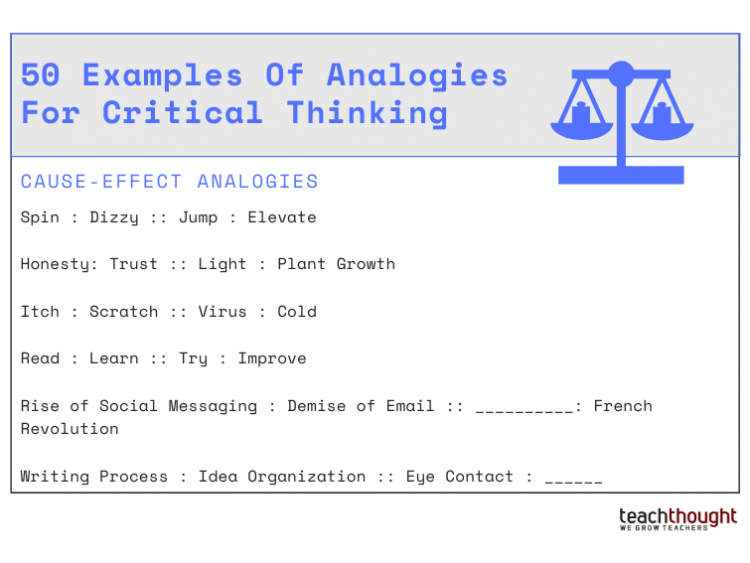
Proportional analogies establish amathematical relationship* between two pairs of terms, often expressed as an equation or ratio. They demonstrate a consistent relationship between two things that mirrors a relationship between two other things.For example:* Concept: As a conductor is to an orchestra, so is a captain to a ship.
Explanation
A conductor directs an orchestra, just as a captain directs a ship.
Both roles involve leadership, coordination, and ensuring the smooth operation of a complex group or system.
Strengths
They highlight relationships and patterns, which are useful in logic, reasoning, and problem-solving. They are also good for showing the underlying principles.
Weaknesses
They can be challenging to create if the relationships are not clear or if the audience is unfamiliar with the elements of the analogy. Overly complex proportional analogies can be confusing.
Comparing Analogy Types
Understanding the different types of analogies and their characteristics allows for a more strategic approach to concept explanation. The following table summarizes the key features of each type.“`html
| Type of Analogy | Focus | Strengths | Weaknesses |
|---|---|---|---|
| Structural | Structure/Organization | Visualizing complex systems, Breaking down abstract concepts | Superficial similarities, Audience unfamiliarity with structure |
| Functional | Function/Purpose | Explaining processes, Role of different parts | Oversimplification, Superficial similarity of function |
| Proportional | Mathematical Relationship | Highlighting relationships, Showing underlying principles | Unclear relationships, Audience unfamiliarity with elements |
“`
Avoiding Misuse and Misinterpretation
Analogies are powerful tools for explaining complex concepts, but they also come with potential pitfalls. Over-reliance on analogies, or a failure to carefully craft and present them, can lead to misunderstandings and inaccurate conclusions. This section explores the dangers of misuse and misinterpretation, offering strategies to ensure clarity and accuracy when using analogies.
Potential Dangers of Over-Reliance
Relying too heavily on analogies can lead to oversimplification and a loss of nuance. The very nature of an analogy, which involves drawing parallels between dissimilar things, inherently involves some degree of simplification. While this can be helpful for understanding, it can also obscure crucial differences.
Examples of Misinterpretation
Analogies, if not carefully chosen and explained, can be easily misinterpreted. Here are some examples:
- The “Brain as a Computer” Analogy: This analogy, popular in cognitive science, compares the brain’s functions to those of a computer. While useful for understanding information processing, it can lead to the misconception that the brain operates in a purely algorithmic way, neglecting the role of emotions, intuition, and the complex network of biological processes that influence human thought. This analogy, when taken too literally, can lead to a mechanistic view of the mind.
- The “Market as a Living Organism” Analogy: This analogy sometimes used in economics, suggests that the market, like a living organism, can self-regulate and adapt. While it highlights the interconnectedness of economic factors, it can lead to the misunderstanding that markets are inherently efficient and just, overlooking issues like market failures, monopolies, and the impact of external factors.
- The “Society as a Body” Analogy: This analogy, which likens different social classes or institutions to the organs of a body, can be misused to justify social hierarchies. It may suggest that each part has a fixed role and that any disruption of this structure is inherently harmful, ignoring the potential for social change and the need for equity.
Strategies for Ensuring Accuracy and Clarity
To mitigate the risks of misinterpretation, it’s essential to employ strategies that ensure accuracy and clarity:
- Identify Limitations: Explicitly state the limitations of the analogy. Make it clear where the analogy breaks down and which aspects of the original concept are not accurately represented. For example, when using the “brain as a computer” analogy, acknowledge that the brain’s emotional and biological aspects are not directly comparable to a computer’s hardware.
- Focus on Relevant Similarities: Concentrate on the specific aspects of the analogy that are most relevant to the concept being explained. Avoid drawing parallels that are tangential or that could lead to confusion.
- Provide Context: Offer sufficient context to ensure that the audience understands the analogy’s purpose and scope. This includes defining the key terms and concepts involved.
- Use Multiple Analogies: Employing several analogies can provide a more comprehensive understanding of the concept, compensating for the limitations of any single analogy.
- Encourage Critical Thinking: Encourage the audience to question the analogy and to consider its potential flaws. This can be done by asking questions or by presenting alternative perspectives.
Addressing Potential Misconceptions
Proactively addressing potential misconceptions that may arise from an analogy is crucial.
- Anticipate Common Misunderstandings: Consider what misunderstandings are most likely to arise based on the analogy you’re using and the audience’s background knowledge.
- Explicitly Correct Misconceptions: Directly address potential misconceptions by stating what the analogy
-doesn’t* mean. For example, if using the “society as a body” analogy, you might explicitly state that the analogy does not imply that social inequalities are natural or inevitable. - Provide Counter-Examples: Offer examples that illustrate the limitations of the analogy and the ways in which the original concept differs.
- Encourage Feedback: Encourage the audience to ask questions and to share their own interpretations of the analogy. This provides an opportunity to clarify any misunderstandings.
Practice and Refinement
Mastering the art of using analogies effectively requires consistent practice and a commitment to refining your skills. This section provides exercises, feedback mechanisms, and evaluation tools to help you hone your ability to explain complex concepts using analogies, ensuring clarity and understanding.
Exercises for Practicing Analogies
Regular practice is essential for developing proficiency in crafting and using analogies. The following exercises are designed to help you build this skill:
- Concept to Analogy Matching: Select a list of complex concepts (e.g., photosynthesis, the internet, the stock market). Provide a corresponding list of potential analogies (e.g., a factory, a network of roads, a casino). Your task is to match each concept with the most suitable analogy, justifying your choice with a brief explanation. This exercise enhances your ability to identify appropriate analogies.
- Analogy Creation Challenge: Choose a complex concept you are unfamiliar with (e.g., quantum entanglement, blockchain technology). Research the concept, then attempt to create at least three different analogies to explain it to a non-expert audience. Compare and contrast the strengths and weaknesses of each analogy. This exercise improves your creative thinking and analogical reasoning skills.
- Analogy Critique and Revision: Find examples of analogies used in articles, books, or videos. Critically evaluate each analogy’s effectiveness. Identify its strengths, weaknesses, and areas where it could be improved. Then, revise the analogy, suggesting specific changes to make it clearer, more accurate, or more engaging. This exercise strengthens your analytical and revision skills.
- Concept-to-Analogy Speed Round: Set a timer (e.g., 5 minutes). Choose a complex concept. Within the time limit, brainstorm as many analogies as possible to explain it. The focus here is on generating a wide range of potential analogies quickly, without worrying about perfection. This exercise boosts your fluency in analogical thinking.
- Audience-Specific Analogy Design: Choose a complex concept. Develop one analogy tailored for children, another for teenagers, and a third for adults. Explain how the analogies differ in terms of complexity, vocabulary, and the specific aspects of the concept they emphasize. This exercise develops your ability to adapt your analogies to different audiences.
Feedback Methods for Improving Analogy Use
Receiving and incorporating feedback is crucial for improving the effectiveness of your analogies. The following methods provide valuable insights:
- Peer Review: Ask a colleague or friend to review your analogies. Provide them with the concept you are explaining and the analogy you have created. Encourage them to identify areas of confusion, inaccuracies, or weaknesses. Their perspective as an audience member is invaluable.
- Self-Critique: After creating an analogy, take time to critically evaluate it yourself. Ask yourself the following questions: Does it accurately represent the concept? Is it clear and easy to understand? Is it engaging? Are there any potential areas of misinterpretation?
- Audience Testing: Present your analogy to a small group of people who are unfamiliar with the concept. Observe their reactions and ask for feedback. Pay attention to the questions they ask, the areas where they seem confused, and the parts they find most helpful.
- Record and Review: Record yourself explaining a concept using an analogy. Review the recording to identify areas where your explanation could be improved. Pay attention to your tone, body language, and the clarity of your language.
- Expert Consultation: If possible, seek feedback from an expert in the field you are explaining. They can provide valuable insights into the accuracy and relevance of your analogy.
Checklist for Evaluating Analogy Effectiveness
A structured checklist helps you systematically evaluate the quality of your analogies. Use the following checklist as a guide:
- Accuracy: Does the analogy accurately represent the key features and relationships of the concept?
- Clarity: Is the analogy easy to understand? Is the language clear and concise?
- Relevance: Does the analogy focus on the most important aspects of the concept?
- Engagement: Is the analogy interesting and engaging? Does it capture the audience’s attention?
- Familiarity: Is the analogy based on something the audience is likely to be familiar with?
- Limitations: Does the analogy have any limitations? Are these limitations clearly explained?
- Appropriateness: Is the analogy appropriate for the target audience?
- Context: Does the analogy fit the context in which it is used?
- Misinterpretations: Does the analogy avoid potential misinterpretations?
- Overall Impact: Does the analogy effectively convey the concept and promote understanding?
Refining and Improving Analogies Based on Feedback
Feedback provides valuable information that can be used to refine and improve your analogies. Here’s how to effectively use feedback:
- Identify the Problem Areas: Carefully analyze the feedback you receive. Identify the specific areas where the analogy is unclear, inaccurate, or ineffective.
- Brainstorm Solutions: Based on the feedback, brainstorm potential solutions. Consider different ways to revise the analogy, such as:
- Changing the analogy itself.
- Adding more detail to the analogy.
- Simplifying the language used.
- Highlighting the limitations of the analogy.
- Implement Revisions: Make the necessary revisions to the analogy based on the solutions you have identified.
- Test the Revised Analogy: Present the revised analogy to the same audience or a similar group. Ask for feedback again to determine if the revisions have improved its effectiveness.
- Iterate and Refine: Continue to iterate and refine the analogy based on feedback until it effectively conveys the concept and promotes understanding.
For example, let’s say you are explaining the concept of cloud computing to a non-technical audience using the analogy of a library.Initially, your analogy might be: “Cloud computing is like a library. You don’t need to own the books (data) or the building (infrastructure). You just borrow what you need from the library (cloud provider).”Feedback from your audience reveals that they don’t fully understand how the library analogy relates to data storage and access.
You could refine it by:* Adding more detail: “Cloud computing is like a library. You don’t need to own the books (your data) or the library building (the servers and infrastructure). You can access the books (your data) from anywhere with a library card (internet connection) and you can borrow as many books (amount of storage) as you need.”
Highlighting limitations
“However, it’s important to note that, like a library, the cloud has limitations. You need to make sure the library (cloud provider) is reliable, and the books (data) are properly cataloged and organized.”By actively seeking and incorporating feedback, you can continuously improve your analogies and become more effective at explaining complex concepts.
Examples of Successful Analogies
Analogies, when crafted well, have the power to transform complex ideas into easily digestible concepts. They provide a bridge between the unknown and the familiar, making abstract principles relatable and memorable. This section explores several famous analogies and examines their effectiveness, sharing stories of how they have illuminated difficult concepts and the lasting impact they’ve had.
Illustrative Examples of Effective Analogies
Analogies are frequently employed across various fields, from science and philosophy to business and everyday communication. Their success lies in their ability to simplify intricate ideas, allowing for a deeper understanding and retention of information.
- The Brain as a Computer: This analogy, widely used in cognitive science, compares the brain’s functions to those of a computer. It highlights the brain’s processing capabilities, storage of information (memory), and the execution of instructions (thoughts and actions). While this analogy has limitations (the brain is far more complex than a computer), it helps to explain fundamental cognitive processes in an accessible way.
- The Immune System as an Army: This analogy effectively portrays the immune system’s defense mechanisms. The body’s immune cells (like white blood cells) are presented as soldiers, pathogens (viruses and bacteria) as invaders, and antibodies as weapons. This analogy makes the complex processes of the immune response easier to grasp. It simplifies the understanding of how the body fights off infections and maintains health.
- The Universe as a Balloon: Used to explain the expansion of the universe, this analogy helps visualize how galaxies are moving apart from each other. Imagine dots drawn on a balloon representing galaxies. As the balloon inflates, the dots move further apart, demonstrating the expanding universe. This analogy is particularly effective in conveying the concept of cosmic expansion in a way that is easily understood, even by those unfamiliar with astrophysics.
- DNA as a Cookbook: This analogy illustrates the function of DNA in determining the characteristics of an organism. The DNA sequences are represented as the recipes in a cookbook, providing the instructions for building and maintaining the organism. Each gene, or specific section of DNA, is like a recipe for a particular trait or protein. This analogy simplifies the complex concept of genetic information and its role in development and inheritance.
Stories of Analogies Clarifying Complex Ideas
The power of analogies is evident in numerous instances where they have served as pivotal tools for understanding and knowledge dissemination. They facilitate the comprehension of intricate concepts by drawing parallels to more familiar domains.
- Einstein’s Elevator: Albert Einstein used the analogy of an elevator to explain his theory of general relativity. Imagine an elevator accelerating upwards. An observer inside would feel a force pushing them down, similar to gravity. This analogy helped explain how gravity is not a force, but rather a curvature in spacetime caused by mass and energy. It enabled a clearer understanding of a complex scientific concept.
- Newton’s Apple: The story of Isaac Newton observing an apple falling from a tree, leading him to formulate the law of universal gravitation, is itself an analogy. The falling apple served as a relatable example of gravity’s effect, extending beyond the Earth to encompass the entire universe. This simple observation provided a foundational understanding of how objects attract each other.
- The “Prisoner’s Dilemma” in Game Theory: The Prisoner’s Dilemma, a classic problem in game theory, uses a narrative analogy to illustrate strategic decision-making. Two suspects are arrested and interrogated separately. Each must decide whether to cooperate with the other or defect. This analogy explains the dynamics of cooperation, competition, and trust in strategic interactions.
The Impact of Successful Analogies
The successful application of analogies can significantly enhance understanding, promote critical thinking, and facilitate the dissemination of knowledge across diverse audiences. These tools have left a lasting impact on education, communication, and scientific progress.
- Improved Understanding: Analogies break down complex information into more manageable parts, leading to a deeper and more intuitive understanding of concepts.
- Enhanced Retention: By connecting new information to existing knowledge, analogies make it easier to remember and recall complex ideas.
- Wider Dissemination: Analogies simplify technical jargon, making complex ideas accessible to a broader audience, including non-specialists.
- Stimulation of Creativity: Analogies can inspire new insights and perspectives by encouraging people to see connections between seemingly unrelated concepts.
“All the world’s a stage, And all the men and women merely players; They have their exits and their entrances, And one man in his time plays many parts.”
- William Shakespeare,
- As You Like It*.
The analogy of the world as a stage and people as actors highlights the transient nature of life and the various roles individuals play throughout their existence. This analogy encapsulates the human experience in a succinct and memorable manner.
End of Discussion
In essence, using analogies is like building a bridge from the familiar to the unfamiliar. By understanding the core principles, selecting the right analogies, and structuring your explanations effectively, you can transform complex ideas into clear, engaging narratives. Whether you’re teaching a class, giving a presentation, or simply trying to explain something to a friend, the skills you’ve learned here will help you connect with your audience and leave a lasting impression.
Now go forth and explain!